The hidden costs of not tracking your brand.
CharityTracker: From insight to action blog series, issue 6.
Breaking the post-launch blues
Even the most seasoned communicator knows the feeling. You spend months shaping a campaign, the launch lands, the room fills with anticipation – and then, almost immediately, the energy drains away. The post-launch blues. All that graft, all that expectation, followed by a strange quiet. It can feel as if you just whispered into a void.
You may see some promising outputs or encouraging anecdotes, but can you honestly say who heard you, what they took from it, or whether it nudged the dial you needed to move? For organisations doing vital work in a crowded, fast-changing world, that uncertainty shouldn’t be the norm.
When you’re tracking, the picture is different. You get feedback rather than silence. You can see who saw the campaign, how they responded and whether it shifted awareness, credibility or motivation. Instead of a vacuum, you gain momentum. Teams feel re-energised because they have fresh knowledge to take into the next launch – and the means to make it sharper, more targeted and more effective.
Yet some charities are still not using brand and audience tracking to shape their strategies, and the costs of that gap only become visible when it’s late in the day. In this sixth instalment of our Insight to Action series, we unpack those hidden costs – from missed signals to wasted spend and unnoticed progress – and show why continuous insight is increasingly the baseline for charity strategy.
When you can’t see the audience clearly
A charity’s brand is the sum of what people know, feel and expect – the foundation on which every interaction rests. Without tracking insight, you lose sight of how that foundation is shifting.
You won’t know which audiences recognise you, which understand your purpose, or which are drifting away. You can’t tell whether your story resonates, where credibility is weakest, or whether those you most need to reach are genuinely hearing you.
That uncertainty filters into day-to-day decisions. You may be communicating in the right way but to the wrong people. You may be relying on channels that overindex on your warmest groups while missing younger or lower-awareness segments. You may be interpreting campaign performance through internal optimism rather than external reality.
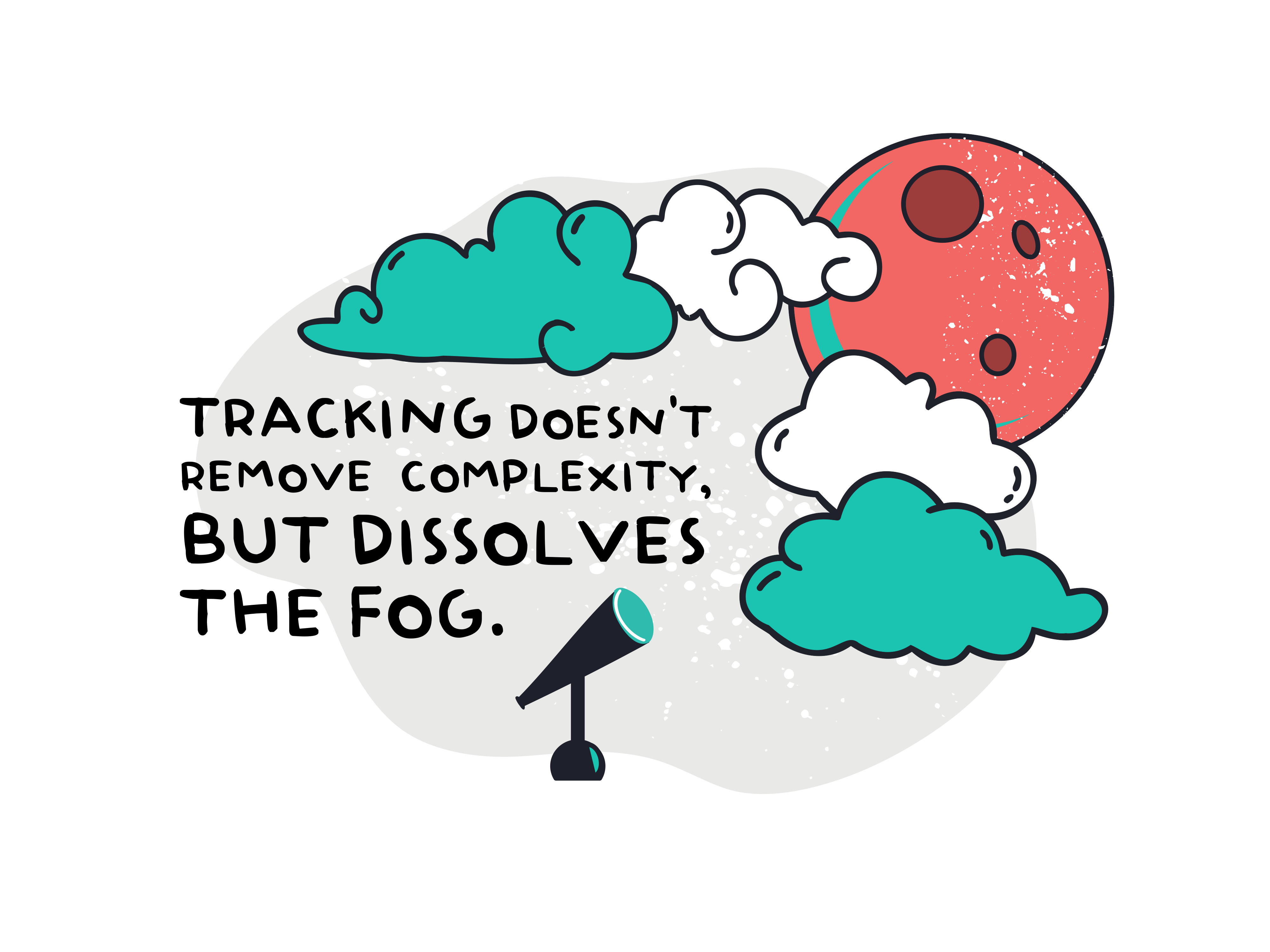
Tracking doesn’t remove complexity, but it dissolves the fog. It shows which brand attributes differentiate you, which drive support, and where you’re performing well – the elements you can build on with confidence.
The quiet costs that accumulate over time
The most damaging brand shifts rarely arrive with fanfare. They creep. A softening in trust among one segment. Declining familiarity in another. A long, slow drift in favourability that only becomes obvious when income softens or service uptake dips.
Without continuous insight, these signals stay buried. Leaders discover the problem when the consequences are already in the numbers – by which point the recovery is longer and harder. A clear read on brand performance acts as an early warning system, surfacing these movements before they become structural issues.
It also brings discipline to internal debates. Instead of confident anecdotes or strong hunches, teams can anchor decisions in the audience’s view of reality. That shift alone prevents months of effort being spent solving the wrong problem.
Good money after bad
One of the most common – and avoidable – costs of limited insight is misdirected investment. When you can’t see the underlying drivers of performance, it’s easy to pour more into tactics that aren’t addressing the real issue.
A campaign underperforms, so the creative team starts again from scratch – when the real barrier is low baseline awareness. A burst of spend creates a one-month lift, which is mistaken for a trend, leading to misplaced confidence in a faltering strategy. Budget continues flowing into channels that feel productive internally but don’t actually reach the audiences with the highest potential.
Tracking interrupts this pattern. It shows what’s moving, where, and why. It helps you understand whether you need reach or relevance, credibility or clarity, consistency or reinvention. And it tells you when to persist, when to pivot and when to stop.
Insight is an investment, not a cost
There is a simple spend-to-save logic here. When insight is viewed as an overhead, it’s an easy budget line to cut. But tracking is not an optional extra – it’s a mechanism that protects every pound you spend.
A modest investment in continuous audience data prevents far larger sums being wasted on misaligned messages, mistimed campaigns or strategies built on outdated assumptions. It helps teams avoid chasing noise, repeating ineffective activity or scaling ideas that only ever worked for a narrow slice of the audience.
More importantly, tracking makes every subsequent decision sharper. It allows you to line up your effort with market shifts rather than working against them. It ensures you’re building on your real strengths, not your perceived ones. And it increases the value of your activity by anchoring it in what audiences actually think and need.
Treat insight as infrastructure – a form of insurance that pays for itself many times over.
When success goes unnoticed
The costs of not tracking your brand aren’t only negative. Sometimes the real loss is the upside you fail to seize.
Charities often overlook areas of quiet strength – the audiences warming to them, the attributes where they outperform peers, the stories that resonate more deeply than expected. Without visibility, these moments pass unrecognised and uncapitalised.
Tracking allows you to spot emerging advantages early. You can double down on what works, build momentum around it, and use it to support income, campaigning or service objectives. You avoid underplaying your progress, and you give teams confidence grounded in evidence, not hope.
Context you can’t afford to miss
Public attitudes don’t stand still. Economic pressure changes how people give. Shifts in trust reshape expectations of transparency and behaviour. Cultural currents influence which issues rise to prominence and which fall away.
When charities rely on internal feels or sporadic research, these wider dynamics are easy to misread. You can mistake a sector-wide trend for a brand-specific issue. You can assume an audience is disengaging from you when the whole category is tightening. Or, equally, you can believe you’re losing relevance when the real story is broader public fatigue.
Tracking puts these movements in context. It benchmarks you against the wider environment so you can read performance in a way that’s proportionate, not reactive.
What becomes possible with continuous tracking
With an always-on view of brand performance, strategy becomes clearer and more confident. You can:
- Identify which audiences most need your attention and where the genuine headroom for growth lies.
- See which messages, attributes and proof-points are differentiating – and avoid converging with close comparators.
- Understand the relationship between attitude shifts and downstream engagement, so you know which metrics to manage.
- Spot issues early and correct course before they become entrenched.
- Sequence investment sensibly, based on evidence rather than internal preference.
- Demonstrate impact to boards and stakeholders in a way that connects activity to outcomes over time.
In other words, you regain control of the narrative rather than being surprised by it.
From insight to action with CharityTracker
CharityTracker gives teams an always-on read of their brand performance, audience priorities and the wider market context – built on a 4,000-strong monthly nationally representative sample. Members can see which attributes differentiate their brand, which drive support and where their strongest opportunities lie. Segment-level insight shows where shifts are happening long before headline numbers move, and our annual reports translate those signals into strategic recommendations for leaders.
Whether you’re a looking to get more from your membership or you’re exploring CharityTracker for the first time, do get in touch – we’d love to continue the conversation.